


What Is the Best Tensile Testing Machine in China?
Choosing the best tensile testing machine in China requires more than comparing prices and maximum force. The right system must match your material, specimen size, testing standard, and production environment. A machine for steel bars may be unsuitable for thin plastic films or medical packaging.
In practical laboratory work, accuracy begins with stable loading and reliable measurement. A quality tensile testing machine should provide a calibrated load cell, controlled crosshead speed, suitable grips, and an accurate extensometer. It should support recognized methods, such as ASTM E8 or ISO 6892-1, when these standards fit your application. The frame should remain rigid during high-force tests. The software should also record stress, strain, elongation, and failure points clearly.
Small details matter. Slipping grips can distort results. Poor alignment can damage specimens unevenly. A noisy workshop may affect repeatability. These issues are easy to overlook during a supplier demonstration. Ask for calibration records, sample test data, service response times, and references from similar industries. Visit the factory if possible. Inspect machining quality, wiring, safety protection, and final assembly.
There is no universal winner.
Chinese manufacturers offer many capable options, but quality varies between models and suppliers. Some machines look impressive yet provide weak technical support after installation. Others appear basic but deliver dependable results for years. A careful evaluation should consider total ownership cost, operator training, spare parts, software updates, and local compliance requirements. This guide compares the key features, manufacturers, and selection criteria that help buyers make a defensible decision. Even experienced engineers should review their assumptions before choosing.
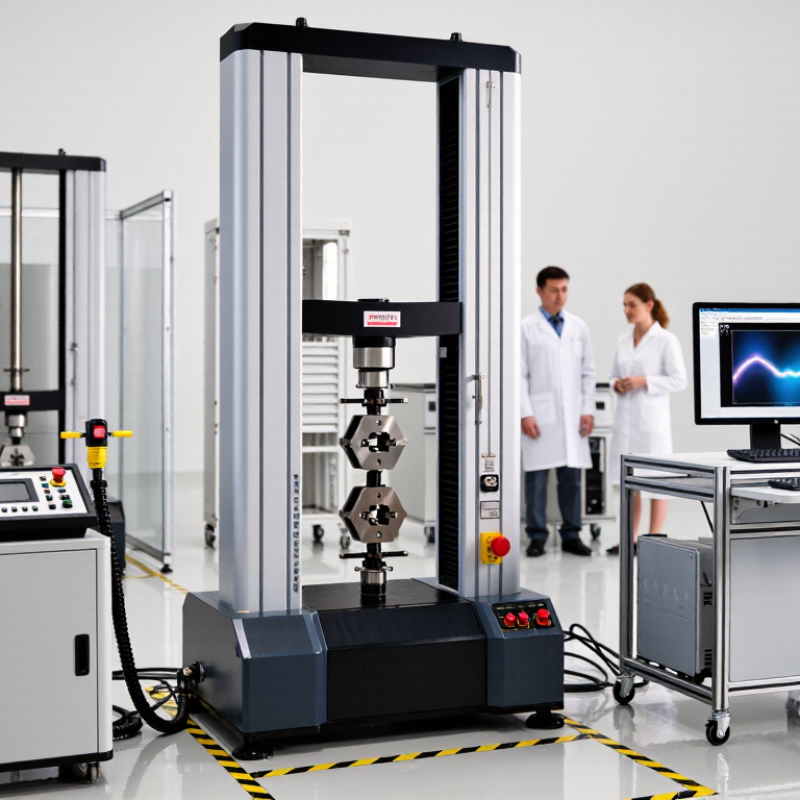
What a Tensile Testing Machine Is and How It Works
What Is the Best Tensile Testing Machine in China?
What a Tensile Testing Machine Is and How It Works
A tensile testing machine measures how a material behaves under controlled pulling force. It holds a prepared specimen between two grips, then separates them at a defined speed. A load cell records force, while an extensometer measures extension across the gauge length. The software converts these readings into stress and strain.
The test reveals yield strength, tensile strength, elongation, and fracture behavior. ASTM E8/E8M and ISO 6892-1 provide widely accepted methods for metallic materials. Their requirements cover specimen dimensions, test speed, alignment, and result reporting. Small errors matter. A loose grip can imitate early failure. Poor alignment can create bending stress.
China’s large manufacturing base makes reliable material verification increasingly important. The World Steel Association reported approximately 1.89 billion tonnes of crude steel production worldwide in 2023. This scale increases demand for repeatable laboratory testing across steel, wire, fasteners, and fabricated parts. A suitable machine should match the expected force range, specimen geometry, accuracy class, and testing frequency.
In practice, the strongest frame is not automatically the best choice. Operators should inspect calibration records, grip surfaces, software traceability, and emergency protection. Data from an instrumented test can still mislead when the specimen is machined poorly. That is an uncomfortable limitation. Selection should therefore consider the complete testing system, not only the machine’s maximum capacity.
What Is the Best Tensile Testing Machine in China? — What a Tensile Testing Machine Is and How It Works
A practical comparison of tensile testing machine types, operating principles, specifications, and selection criteria
| Evaluation Dimension | Typical Options or Range | How It Works or What It Measures | Common Test Materials | Selection Guidance |
|---|---|---|---|---|
| Machine Type | Electromechanical universal testing machine | A motor drives a screw mechanism to move the crosshead while a load cell measures tensile force and an extensometer or crosshead displacement system measures elongation. | Metals, plastics, rubber, textiles, films, wires, composites, and finished products | Best general-purpose choice for laboratories requiring tensile, compression, flexural, and other mechanical tests. |
| Machine Type | Hydraulic universal testing machine | Hydraulic pressure generates force through a piston and actuator. The control system records force, displacement, and deformation during loading. | Structural metals, plates, bars, concrete-related specimens, and high-strength materials | Choose this type when the required force is high, commonly from several hundred kilonewtons upward. |
| Machine Type | Benchtop tensile tester | A compact electromechanical frame applies controlled tension to smaller specimens using interchangeable grips and a load cell. | Packaging, films, adhesive tapes, small plastic parts, medical components, and wires | Suitable when laboratory space is limited and the required capacity is generally below 50 kN. |
| Rated Force Capacity | 1 N to 5 kN | The maximum calibrated force that can be applied and measured within the machine’s rated range. | Thin films, fibers, textiles, small springs, and lightweight packaging | Use a capacity close to the expected maximum test force for better measurement resolution. |
| Rated Force Capacity | 10 kN to 100 kN | Provides a medium force range for routine testing of standard laboratory specimens and industrial components. | Plastics, rubber, metals, fasteners, composites, and cables | Often the most versatile range for general materials testing laboratories. |
| Rated Force Capacity | 200 kN to 2,000 kN or higher | Generates high tensile or compressive loads through a reinforced electromechanical or hydraulic frame. | Steel bars, structural components, heavy chains, concrete specimens, and large composites | Requires a rigid foundation, suitable safety guarding, and adequate laboratory space. |
| Load Measurement | Strain-gauge load cell | Elastic deformation inside the load cell changes the electrical signal, which is converted into force by the data acquisition system. | Most laboratory tensile and compression tests | Verify calibration accuracy, overload protection, resolution, and traceability to recognized standards. |
| Strain Measurement | Mechanical or video extensometer | The extensometer measures the change in gauge length directly, allowing calculation of engineering strain and modulus. | Metals, plastics, composites, and materials requiring accurate elongation data | Use an extensometer when precise yield strain, elastic modulus, or elongation-at-break data is required. |
| Crosshead Speed | Approximately 0.001 to 1,000 mm/min, depending on configuration | The crosshead moves at a controlled speed to apply deformation at the rate specified by the selected test method. | Metals, plastics, rubber, films, textiles, and adhesives | Confirm that the speed range and speed accuracy match the applicable material standard. |
| Test Results | Force, displacement, stress, strain, tensile strength, yield strength, and elongation | Software calculates material properties from force and dimensional data, then displays curves such as force–displacement or stress–strain. | All materials tested within the machine’s operating range | Check whether the software supports raw-data export, report templates, audit trails, and automatic calculations. |
| Grip Configuration | Wedge grips, pneumatic grips, roller grips, thread grips, and film grips | Grips hold the specimen while minimizing slippage, crushing, or unintended stress concentration. | Metals, films, textiles, rubber, wire, rope, and molded specimens | Grip design should match specimen geometry, surface condition, thickness, and expected failure mode. |
| Control Mode | Force control, displacement control, or strain control | The controller regulates the selected test variable according to a programmed loading profile. | Routine quality control, research testing, cyclic loading, and advanced material characterization | Displacement control is common for basic tensile tests; strain control is useful for precise material studies. |
| Applicable Standards | ISO 6892-1, ASTM E8/E8M, ISO 527, ASTM D638, ISO 37, and related methods | Standards define specimen dimensions, conditioning, gripping, test speed, calculations, and reporting requirements. | Metals, plastics, rubber, films, and other standardized specimens | Choose a machine and accessories that satisfy the standards required by the target market or industry. |
| Working Principle | Controlled loading until a defined endpoint or specimen failure | The machine clamps the specimen, applies tensile force, records synchronized measurements, and stops when the programmed condition is met. | Any specimen suitable for the selected grips and force range | A suitable machine should provide stable control, synchronized data acquisition, emergency stopping, and specimen protection. |
| Safety Features | Guarding, emergency stop, overload protection, travel limits, and break detection | Safety systems reduce risk from specimen fragments, excessive force, unexpected crosshead movement, and equipment overload. | Especially important for brittle, high-strength, or high-energy specimens | Prioritize safety guarding and automatic shutdown for high-force or destructive testing. |
| Best Overall Selection | Calibrated electromechanical universal testing machine with interchangeable grips and extensometer support | Combines flexible force capacity, programmable speed, accurate force measurement, direct strain measurement, and multi-material compatibility. | Metals, plastics, rubber, textiles, films, composites, wires, and finished products | For most general laboratories, the best choice is determined by required force, standards, specimen dimensions, accuracy, and after-sales service—not by price alone. |
Related Posts
-
How to Choose the Right Universal Tensile Machine for Your Needs?
-
China Top Universal Tensile Testing Machine Manufacturers
-
Best Universal Tensile Testing Machines for Accurate Material Testing?
-
How to Choose a Small Tensile Testing Machine?
-
What is a Tensometer Machine and How Does it Work?
-
10 Essential Tips for Using a Rubber Tensile Testing Machine Effectively