Why Choose EPS Casting Pattern Mould for Foundry Production?
Why Choose Eps Casting Pattern Mould for Foundry Production? The question matters as foundries face tighter cost, weight, and complexity demands. The American Foundry Society’s 2023 World Census of Castings reported global production near 109 million metric tons. That scale reveals a competitive industry where small process improvements can influence many production lines. Eps Casting Pattern Mould technology offers one practical response. It creates a disposable foam pattern that reproduces complex cavities without traditional parting lines. Fewer assembly steps can reduce pattern tooling and improve design freedom.
The advantages become visible on the shop floor. A foam pattern may include ribs, channels, and internal shapes in one integrated form. Operators can place the pattern into unbonded sand, compact it carefully, and pour metal through the coated surface. This approach can reduce machining allowances and simplify certain castings. ISO 8062-3:2023 provides a useful framework for casting dimensional tolerances and machining allowances. It reminds engineers that near-net shape still requires measurement, not optimism. The process is not magic.
Plant trials also expose weaknesses. Foam density, coating permeability, sand compaction, and pouring temperature must work together. A small coating crack can produce a rough patch or visible penetration. Improper ventilation may also affect workplace conditions and process stability. Therefore, this introduction examines Eps Casting Pattern Mould through productivity, design flexibility, quality control, and environmental responsibility. It will compare reported industry evidence with practical foundry observations. Some claims may sound attractive, yet every claim needs a controlled trial. That is where the real answer begins.
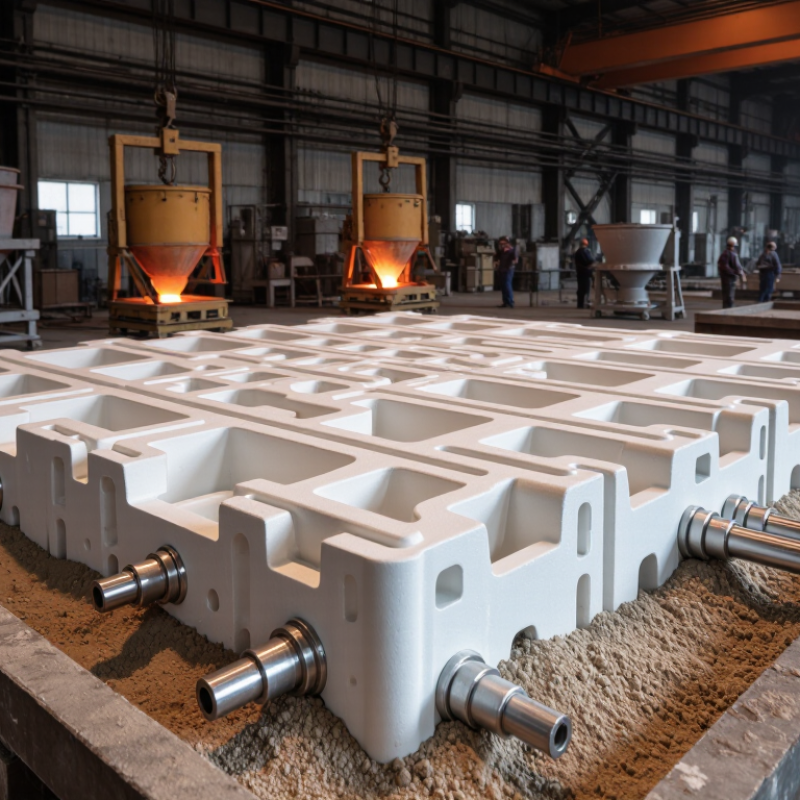
What Is an EPS Casting Pattern Mould?
Why Choose EPS Casting Pattern Mould for Foundry Production?
An EPS casting pattern mould is a reusable tool for producing foam patterns in lost foam casting. EPS means expanded polystyrene, a lightweight material with fine, closed-cell structure. During production, heated beads expand inside the mould and form the required shape. The finished pattern later receives a refractory coating and enters a sand-filled casting box.
The mould usually consists of accurately machined metal sections, guide pins, vents, and a controlled parting line. Small details matter. A blocked vent can leave weak areas, while poor alignment may create visible steps on the foam pattern. Operators also consider metal shrinkage, coating thickness, and foam expansion before approving the final dimensions. The mould is not the casting cavity itself. It creates the temporary pattern that molten metal replaces.
EPS tooling can reproduce ribs, holes, curved surfaces, and internal passages with fewer assembly steps. It also reduces the need for traditional core boxes in suitable applications. However, it is not automatically the best choice. Complex tooling may require careful maintenance, and fragile foam patterns can be damaged during coating or handling. This part is sometimes underestimated. A reliable process needs stable bead density, accurate temperature control, and regular inspection of vents and parting surfaces. Small process errors can become large casting defects.
How EPS Patterns Support the Lost Foam Casting Process
EPS casting pattern moulds make the lost foam process practical for complex foundry production. An EPS pattern is shaped like the final casting, including ribs, cavities, and delicate contours. During pouring, molten metal replaces the evaporating foam inside the sand mould. No pattern withdrawal is required. This reduces parting lines and supports near-net-shape manufacturing.
The 2023 World Foundry Census reported roughly 110 million tonnes of castings worldwide in 2022. Such volume increases pressure to reduce machining, scrap, and pattern costs. The U.S. Department of Energy’s Metal Casting Technology Roadmap also links near-net-shape casting with lower material use and reduced machining demand. EPS patterns can support these goals, especially for automotive housings, pump bodies, and agricultural components.
It is not magic. Pattern density, bead fusion, coating permeability, and pouring temperature directly affect surface quality. Poor venting may create folds or gas defects. Shrinkage still matters. In production trials, technicians should check foam density, coating thickness, and dimensional stability before scaling output. A 1 mm coating variation can change metal flow behavior around narrow sections. The process also needs disciplined sand compaction and steady pouring practice. Industry experience shows that small pattern flaws often become large casting defects. That is why EPS mould design should combine CAD accuracy with physical trial castings, measured inspection, and documented process feedback.
Production Applications and Selection Considerations for EPS Moulds
Why Choose EPS Casting Pattern Mould for Foundry Production?
EPS casting pattern moulds are widely used in lost foam casting for complex housings, pump bodies, engine parts, and agricultural machinery. The foam pattern reproduces the final shape without traditional parting lines. It can also reduce core assembly and simplify the production of internal passages. In practical foundry work, this is useful for components with deep cavities, curved surfaces, or repeated design changes. The pattern remains lightweight. Handling is easier.
Selection requires more than checking the mould’s price. EPS density affects strength, vaporization behavior, and surface quality. A low-density pattern may reduce material use, but it can deform during transport or coating. A denser pattern offers better support, although it may need more heat and time to disappear. Bead size also matters. Fine beads generally produce smoother surfaces and sharper details. Dimensional accuracy depends on mould precision, cooling control, and storage conditions. Even small humidity changes can influence foam stability.
The mould should match the alloy, casting size, coating system, and production volume. For large iron castings, stronger patterns and controlled coating thickness are often necessary. For aluminum parts, fine details and clean vapor evacuation may receive greater attention. Check gating design, foam bonding, venting, and compatibility with the refractory coating. Test pieces are worth making before full production. They reveal flaws that drawings miss. The choice is rarely perfect at the first attempt; process records and operator feedback should guide the next adjustment.
Why Choose EPS Casting Pattern Mould for Foundry Production?
EPS pattern selection is closely related to material density and compressive resistance. Higher-density EPS generally provides better handling strength and surface stability, while lower-density material is easier to cut, shape, and vaporize during lost-foam casting.
Selection guidance: Lower-density EPS is suitable for large, simple patterns where lightweight handling is important. Medium-density EPS is commonly preferred for general industrial castings. Higher-density EPS is more appropriate for thin sections, detailed geometries, repeated handling, and applications requiring improved dimensional stability. Actual values should be verified against the selected EPS grade and supplier datasheet.