


What Are the Top Types of Industrial Power Supply in 2026?
Industrial Power Supply choices are changing as factories add automation, robotics, and connected equipment. The International Energy Agency’s Electricity 2024 report projected global electricity demand would grow by an average of about 3.4% annually from 2024 to 2026. That forecast describes demand, not power-supply sales. Still, it highlights the pressure on facilities to deliver stable, efficient power as electrical loads expand.
The right supply depends on the load, installation environment, and consequences of interruption. A compact DIN-rail switching supply may suit a control cabinet, while a DC-DC converter can adapt voltage near a sensor or controller. Linear supplies still have a place where low noise matters, despite their lower efficiency and greater heat output. UPS systems support critical loads during outages; programmable supplies serve testing and process development. High-voltage units meet specialized needs, but require careful matching to equipment and safeguards.
There is no universal winner. Even similar production lines can need different combinations. IEA analysis provides useful energy context, but it cannot replace a site-level review of voltage, current, temperature, redundancy, and expansion plans. Small details matter: cabinet airflow, for example, can affect a supply’s service life. This guide compares the leading types expected to matter in 2026, explaining their strengths, limitations, and practical selection criteria. The distinctions are not always neat. A hybrid setup may be the sensible answer.
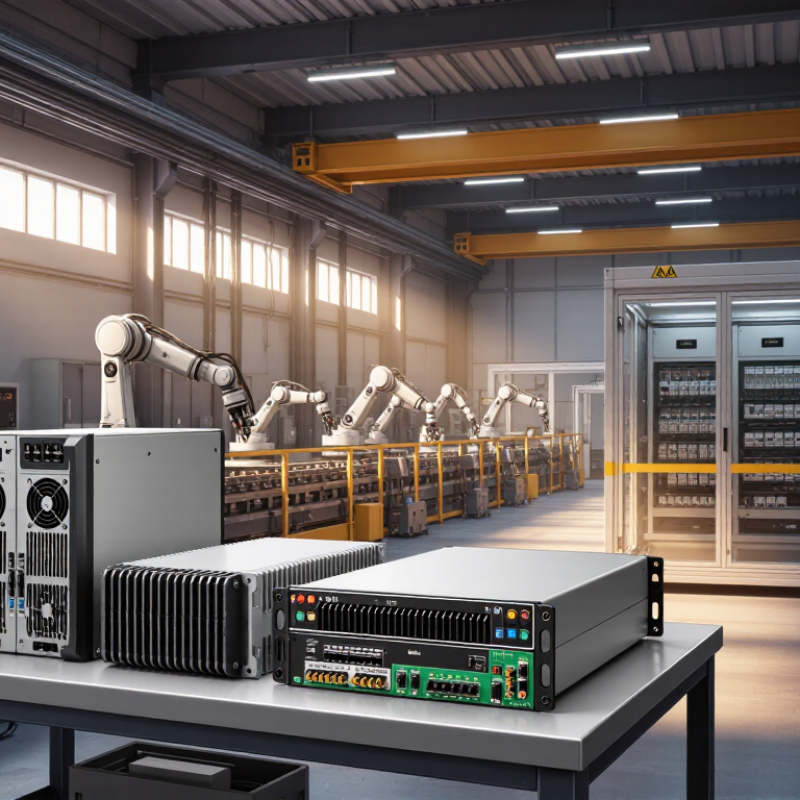
How Industrial Power Supplies Are Classified in 2026
Industrial power supplies are classified by how they convert energy, regulate output, and fit into equipment. AC-to-DC units convert facility mains power into stable DC for controls, sensors, and actuators. DC-to-DC converters adjust one DC voltage to another, often inside machines or control cabinets. Switching designs are common where compact size and efficiency matter; linear supplies can suit applications needing very low electrical noise.
Form factor is another useful classification. DIN-rail models clip onto cabinet rails, while enclosed units protect internal components with a casing. Open-frame supplies are installed inside equipment, where the machine provides additional protection. Supplies may also be grouped by output behavior, such as fixed-voltage, adjustable, redundant, or programmable models. The categories can overlap. A catalog label alone may not explain how a unit performs under heat or load.
Tips: Check input range, output voltage, current capacity, and protection ratings against the actual installation. Leave room for airflow, and review derating guidance for hot cabinets. A small sizing error can cause nuisance shutdowns. I have seen selections look right on paper, then run warm in a crowded enclosure. That deserves a second look.
What Are the Top Types of Industrial Power Supply in 2026? - How Industrial Power Supplies Are Classified in 2026
| Type | Conversion or Operating Principle | Common Output | Typical Industrial Uses | Key Selection Considerations |
|---|---|---|---|---|
| AC-DC Switched-Mode Power Supply (SMPS) | Converts AC input to regulated DC using high-frequency switching and electronic control. | Commonly 12 V, 24 V, or 48 V DC; output capacity varies by design. | PLC and control cabinets, sensors, industrial networking equipment, and machine controls. | Check input range, output current, efficiency, overload protection, cooling, and suitability for the installation environment. |
| Linear Power Supply | Uses a transformer, rectifier, and linear regulation to produce a stable DC output. | Regulated DC outputs, often at low to moderate power levels. | Low-noise instrumentation, sensitive analog circuits, and test equipment. | Can provide low electrical noise, but is generally less efficient and produces more heat than an SMPS of comparable output. |
| DC-DC Converter | Changes one DC voltage level to another; designs may be isolated or non-isolated. | Step-down, step-up, or polarity-changing DC outputs, including common control and communication voltages. | Vehicle and mobile machinery electronics, distributed control systems, and equipment powered from DC buses or batteries. | Match input and output ranges, isolation requirements, regulation, transient response, and available power. |
| Uninterruptible Power Supply (UPS) | Uses stored energy, typically in batteries, to maintain power when the normal source is interrupted or falls outside acceptable limits. | AC output, DC output, or both, depending on the system design. | Industrial control systems, servers, communication equipment, and processes that need ride-through or controlled shutdown. | Consider required backup time, load type, transfer behavior, battery monitoring, maintenance, and operating temperature. |
| Industrial Rectifier and Battery Charger | Converts AC to DC and regulates charging current or voltage for a connected battery system. | DC output matched to the system voltage and battery chemistry. | Substations, emergency and standby systems, process facilities, and DC control-power installations. | Verify battery compatibility, charging profile, ripple limits, monitoring features, and any required redundancy. |
| Programmable DC Power Supply | Provides adjustable, regulated DC output with settings controlled locally or through an interface. | Adjustable voltage and current within the unit’s rated operating limits. | Production testing, laboratory work, equipment commissioning, and automated test systems. | Check output accuracy, stability, programming interfaces, protection modes, and whether the supply supports constant-voltage and constant-current operation. |
Specifications and output ranges vary by application and design. Select a supply based on the load, input source, protection requirements, installation conditions, and applicable electrical standards.