How to Choose the Right Copper Alloy Winding Wire
Choosing the right Copper Alloy Winding Wire is a practical engineering decision, not a simple purchasing task. The conductor must carry current efficiently, survive repeated bending, and remain stable under heat. Its alloy, diameter, temper, insulation, and surface finish all influence final performance. A wire that looks ideal in a catalog may behave differently on a fast winding line.
Motor-design expert Thomas A. Lipo has emphasized a related principle: “Material choice is part of the machine design, not an afterthought.” This idea matters when comparing copper alloys. Higher strength may reduce breakage during tensioning, but it can also affect conductivity. Better conductivity may improve efficiency, yet the softer wire could suffer during tight forming. There is no perfect option.
Real selection begins with operating details. Check current density, winding temperature, bend radius, slot dimensions, and expected service life. Ask whether the enamel system matches the thermal class and manufacturing process. Review test data, not only marketing claims. Resistance measurements, elongation results, and repeated-bend trials can expose weaknesses early. Small samples help.
The environment also matters. Moisture, vibration, corrosive gases, and frequent thermal cycling can change the preferred alloy. A traction motor may need different priorities than a compact transformer or precision actuator. Cost remains important, but replacing failed windings is usually more expensive. That assumption can fail, too, when production volumes are low.
This guide examines these trade-offs clearly. It also recognizes an uncomfortable truth: supplier data may not reflect every real-world condition. Careful engineers verify the wire within the actual winding process, then document what worked and what did not.
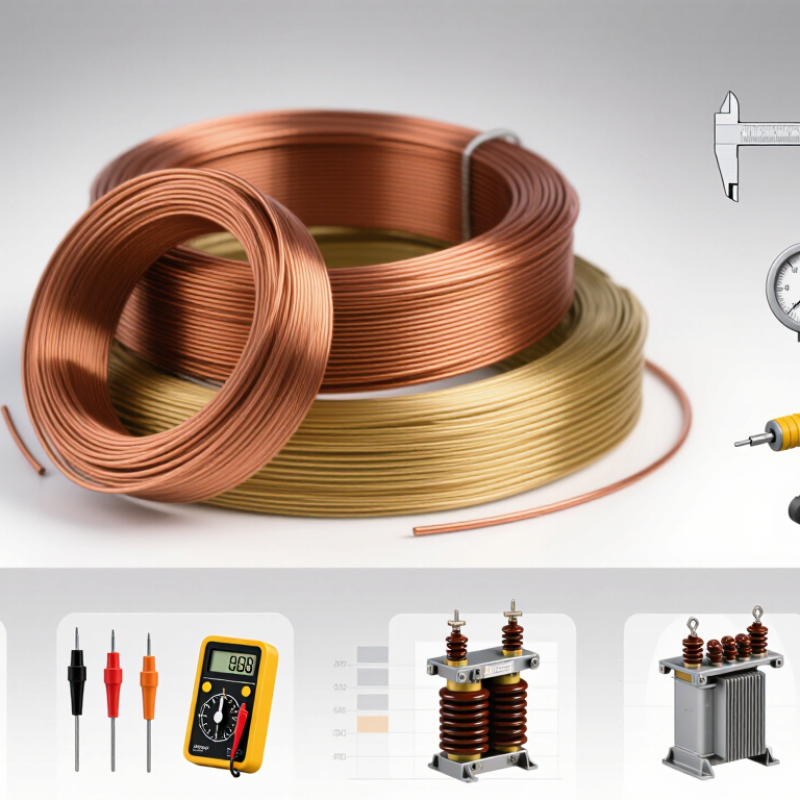
Set Electrical Targets: 0.01724 Ω·mm²/m Copper Resistivity at 20°C
How to Choose the Right Copper Alloy Winding Wire
Set Electrical Targets: 0.01724 Ω·mm²/m Copper Resistivity at 20°C
For winding wire, begin with a measurable electrical target. The reference value is 0.01724 Ω·mm²/m at 20°C. IEC 60028 links this value with 100% IACS conductivity, approximately 58 MS/m. It represents annealed copper, not every copper alloy. Alloy additions can improve strength or heat resistance, but usually increase resistivity.
Small losses become visible in practice. A 100-meter winding using 1 mm² wire has about 1.724 Ω at this reference value. At 10 A, that resistance produces roughly 172 W of heat. Check the actual conductor area, not only the nominal diameter. Enamel thickness changes the outside measurement.
Use a four-wire resistance test, controlled at 20°C, and record the correction method. ASTM B193 provides a recognized approach for testing electrical conductor resistivity. NEMA MW 1000 also provides magnet-wire requirements for dimensions and insulation systems. Ask for lot-specific resistance data.
Temperature matters. Copper’s resistance rises by roughly 0.393% per °C near room temperature. A winding measured at 80°C may show substantially higher resistance. This is where selection becomes less tidy. A stronger alloy may survive vibration better, yet reduce efficiency. I would compare resistance, tensile strength, elongation, insulation class, and bend performance together. A low-resistance result alone is not enough. 马会
Screen Base Grades: Cu-ETP Contains ≥99.90% Copper and 100% IACS
How to Choose the Right Copper Alloy Winding Wire
For screening base grades, Cu-ETP is a dependable starting point. It contains at least 99.90% copper by mass. ASTM B49 identifies this purity level for electrolytic tough-pitch copper. The grade also contains controlled oxygen, which supports conductivity and manufacturing stability. It is widely used for magnet wire conductors, motor windings, and transformer coils.
The key reference is 100% IACS conductivity at 20°C. IEC 60028 defines this benchmark as approximately 58 MS/m, with a resistivity near 0.017241 Ω·mm²/m. A Cu-ETP conductor meeting 100 IACS can reduce resistive heating in a tightly packed winding. That matters when the wire runs continuously inside a warm motor slot. Small diameter changes still affect resistance.
Do not treat the purity figure as a complete quality guarantee. Drawing quality, annealing, surface condition, and temperature can change actual performance. This is where selection becomes less tidy. The International Annealed Copper Standard is useful, but it is a reference value, not a promise for every finished wire. Request test results for conductivity, tensile strength, elongation, and dimensional tolerance. EN 1976 data also helps confirm the Cu-ETP chemical range. In practice, a slightly lower measured conductivity may reveal a processing issue rather than a poor alloy choice.
Compare Alloy Conductivity: CuCrZr Commonly Delivers 75–85% IACS
Choosing copper alloy winding wire starts with conductivity, not tensile strength alone. CuCrZr commonly delivers 75–85% IACS at 20°C, according to industry material data and technical guidance based on the International Annealed Copper Standard. Pure annealed copper equals 100% IACS under this reference system. CuCrZr therefore creates more resistive heat for the same wire size, but it offers greater strength and improved softening resistance during demanding winding processes.
The 75–85% range matters. It is not a fixed material constant. Heat treatment, drawing condition, temperature, and testing direction can shift the result.
For a 1 mm diameter wire at 80% IACS, resistance is approximately 0.027 ohms per meter at 20°C.
A ten-meter winding would approach 0.27 ohms before temperature rises. That small value can become significant in high-current coils. Data from technical conductivity tables published by the Copper Development Association and European copper-industry guidance support this calculation, but production measurements should verify it.
I would compare current density, allowable temperature rise, and available winding space together. Choosing CuCrZr only for its strength can be a costly mistake. The alloy may survive tighter handling, yet the design could require a larger cross-section or stronger cooling.
Check the supplier’s certificate, because “80% IACS” without test conditions is incomplete.
Match Insulation to Heat: Class 155, 180, and 220°C Systems
Choosing the right copper alloy winding wire begins with heat, not conductivity alone. In motor workshops, I have seen excellent wire fail because the insulation system was underrated. Class 155 insulation suits moderate operating temperatures, while Class 180 provides greater thermal endurance. Class 220 is designed for demanding hot-spot conditions, frequent overloads, or compact windings.
The wire alloy must also match the winding process. Higher strength can help during tensioning and insertion, but excessive hardness may increase cracking risks. Check conductivity, elongation, solderability, and compatibility with varnish or resin. The thermal class applies to the complete insulation system, including enamel, slot liners, sleeves, and impregnation materials. A Class 180 wire cannot safely create a Class 180 system if another component reaches its limit earlier. Measure the hot spot. Small details matter.
Tips: Record ambient temperature, current density, and measured winding temperature under real load. Leave practical thermal margin rather than designing at the exact limit. Inspect sample coils after forming and curing. Look for scraped enamel, sharp bends, and uneven resin coverage. A perfect calculation can still miss poor cooling or repeated short overloads. I have also found that installation habits vary between operators, so production checks deserve more attention than many designs allow.
Validate Compliance: IEC 60317 and ASTM B49 Guide Wire Selection
Choosing the right copper alloy winding wire starts with insulation, conductor size, and operating temperature. IEC 60317 should be checked when selecting an insulated winding wire specification. It covers particular wire types, insulation materials, dimensions, and test requirements. Do not treat the standard number as blanket approval. The exact part matters.
ASTM B49 applies mainly to copper rod for electrical purposes. It helps verify feedstock quality before drawing and insulation. Check conductivity, dimensions, tensile behavior, surface condition, and sampling records against the applicable edition. Ask for heat numbers and test reports. Small surface marks can become breaks during fine drawing. That detail is easy to miss.
In practice, compare the supplier’s certificate with the design record and incoming inspection results. Measure conductor diameter at several points, then inspect insulation thickness after winding. Review dielectric breakdown, elongation, flexibility, and thermal-aging data required by the selected IEC 60317 type. IEC and ASTM perform different jobs; one does not replace the other. I have seen teams approve wire from a familiar certificate, then discover a mismatch in coating class. Build a traceable checklist, but leave room for engineering judgment. Standards guide selection; documented evidence validates it.