


Material Testing Blog

HomeMaterial Testing Blog

China Best Car Wiper Blades Manufacturers for Global Buyers

Car Wiper Blades are small components with a critical job: keeping a driver’s view clear through rain, road spray, and seasonal grime. For global buyers, choosing a Chinese manufacturer involves more than comparing unit prices. Fit, material consistency, production capacity, and dependable communication all matter. Small differences can become visible on the windshield.

The scale of the automotive industry helps explain the demand. OICA’s 2023 production statistics report approximately 93.5 million motor vehicles produced worldwide. This is useful context, not a forecast of wiper-blade sales. Replacement needs vary with climate, mileage, vehicle design, and maintenance habits. A blade tested in mild rain may behave differently during heavy downpours or winter exposure. Real conditions matter.

This guide examines Chinese suppliers through practical purchasing criteria: vehicle coverage, rubber and frame options, quality-control procedures, customization, and export experience. Buyers should request clear fitment data and ask how products are checked for streaking, noise, and durability. Certifications and test documents also deserve careful review; a logo alone proves little. It is worth asking for samples. Then compare them on glass, not just in a catalog. Supplier claims can sound polished, and specifications do not answer every question. Even experienced buyers may need to revisit assumptions when a product reaches a new market. The aim here is not to declare one universal winner, but to help buyers assess manufacturers with evidence, useful questions, and realistic expectations.
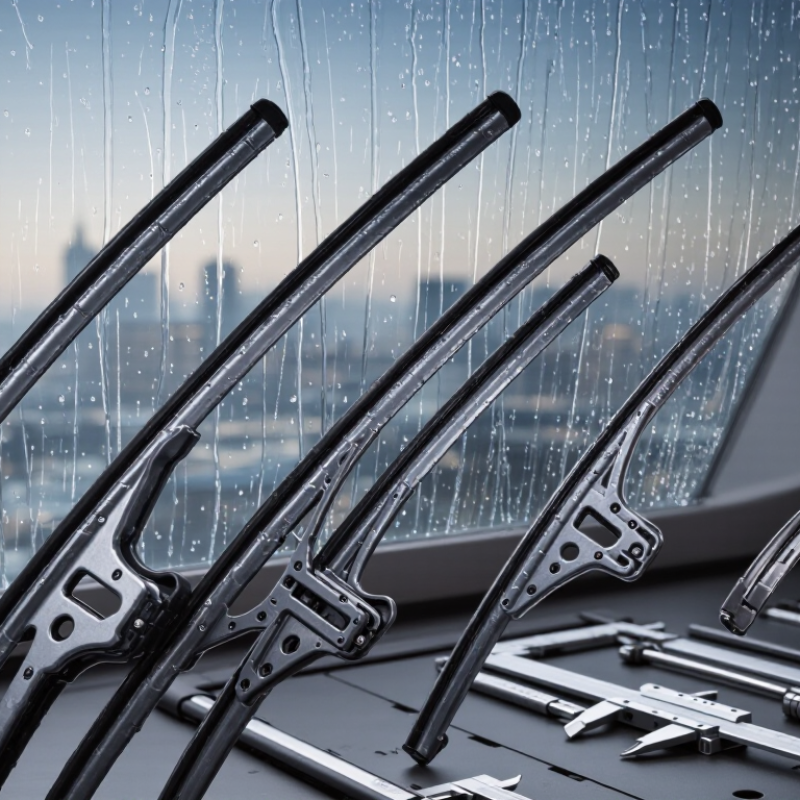
China Best Car Wiper Blades Manufacturers for Global Buyers

What Defines a Leading Car Wiper Blade Manufacturer in China

A leading Chinese car wiper blade manufacturer proves control before claiming scale. OICA recorded 93.5 million motor vehicles produced worldwide in 2023. That volume demands stable supply, not only attractive pricing. Reliable factories inspect rubber hardness, steel tension, connector dimensions, and surface finish. Each batch should carry traceable production records. Small details matter.

Performance testing should reflect real roads. A serious manufacturer checks wiping clarity after repeated cycles, ultraviolet exposure, salt spray, heat, and freezing temperatures. Fit testing must cover common arm designs and replacement conditions. S&P Global Mobility’s 2024 vehicle-age analysis showed that older vehicles remain a major part of the active fleet. Therefore, aftermarket compatibility deserves equal attention to original-equipment projects. Clear packaging data also helps distributors avoid costly returns.

Experience appears in the factory response to failure. Can engineers identify chatter, streaking, or lifted edges quickly? Can they adjust the profile without hiding the defect? Not always. Some suppliers still overemphasize laboratory results and underuse field feedback. That weakness deserves honest review. IATF 16949-based process discipline, documented corrective actions, and independent product testing can strengthen confidence. A capable exporter also understands regional labeling, packaging, and import requirements. Fit matters. Data exposes gaps.

Key Types and Materials Used in Car Wiper Blades

China’s car wiper blade industry serves buyers across many climates and vehicle platforms. Understanding blade types and materials helps importers choose reliable products.

Conventional framed blades use several metal claws to press rubber against the glass. Their galvanized or coated steel frames are affordable and easy to inspect.

Beam blades use a flexible spring-steel spine and usually perform better on curved windshields.

Hybrid blades combine a framed core with an aerodynamic plastic shell. They offer a practical balance between pressure, appearance, and cost.

Rubber remains common because it is economical and easy to mold. Synthetic rubber can provide better resistance to heat, ozone, and cleaning chemicals.

Silicone often lasts longer and leaves a smoother wiping action, but it may cost more.

The wiping edge matters most. A sharp, even edge removes rain without chatter or gray residue. However, no material is perfect. Silicone may attract dust, while low-grade rubber can harden quickly under sunlight.

Professional buyers should request tests for cold flexibility, ultraviolet exposure, ozone aging, salt spray, and repeated wiping cycles. Check the adapter fit on actual vehicle arms, not only in drawings.

A blade may pass a factory inspection yet perform poorly after installation. That uncomfortable gap deserves attention.

Packaging should also protect the rubber from compression, heat, and deformation during long-distance shipping.

How to Evaluate Chinese Wiper Blade Manufacturers

When evaluating Chinese car wiper blade manufacturers, inspect the factory beyond its online catalog. Ask for production photos, equipment details, and recent quality records. A clean assembly line helps, but it does not prove consistent performance. Request samples from different production batches. Compare wiping clarity, frame strength, connector fit, and noise after repeated use.

Material selection needs close attention. Natural rubber, synthetic rubber, and coated compounds behave differently in heat, rain, and freezing conditions. Ask for test data covering ozone resistance, aging, pull strength, and wiping cycles. Confirm whether the laboratory is internal or independent. Documents matter. However, paperwork alone can hide weak testing methods. I once underestimated connector tolerance; a small fitting error caused installation problems during field checks.

Reliable manufacturers explain their quality control process in practical terms. Look for incoming material inspection, in-process checks, final inspection, and traceable batch records. Discuss packaging, carton strength, labeling, and storage conditions before ordering. Export experience can reduce mistakes with documentation and shipping schedules. Still, do not rely only on years in business. Review customer references, response speed, replacement policies, and production capacity during peak seasons. A pilot order is safer than immediate large-volume purchasing. Keep written specifications for rubber hardness, blade length, adapter types, packaging, and acceptable defect limits. Clear records protect both sides when results differ.

China Best Car Wiper Blades Manufacturers for Global Buyers - How to Evaluate Chinese Wiper Blade Manufacturers
Evaluation Dimension Suggested Weight What to Check Evidence to Request Evaluation Method
Product Range and Application Coverage 10% Coverage of conventional, beam, hybrid, rear, and refill products, plus available lengths, adapters, and left- or right-hand-drive applications. Current product catalogue, application list, dimensional drawings, and adapter compatibility information. Compare the catalogue with your target vehicle parc. Check that fitment data identifies vehicle model years and relevant market variations.
Fitment Accuracy 12% How vehicle applications are identified and how blade length, connector type, curvature, and installation clearance are checked. Fitment database sample, application development procedure, sample labels, and records of fitment checks. Choose representative applications from your target markets and physically verify fit, secure attachment, clearance, and correct installation instructions.
Wiping Performance 12% Wiping consistency, streaking, chatter, contact across the swept area, and performance under the conditions relevant to the intended vehicles. Test procedures, sample test reports, defined acceptance criteria, and retained-sample policy. Test samples on suitable glass and wiper arms using an agreed procedure. Define pass criteria before testing rather than relying on unsupported performance claims.
Materials and Construction 8% Rubber or other wiping-element material, frame or beam construction, coatings, end caps, connectors, and consistency between approved samples and production. Material specifications, bills of materials, supplier controls, and change-notification procedure. Review specifications and inspect samples. Require written approval before changes to materials, tooling, or critical components.
Durability and Environmental Validation 10% Resistance to wear and environmental exposure relevant to the product, such as temperature variation, sunlight, moisture, and corrosion where applicable. Test plans and reports showing sample identification, test conditions, duration, results, and acceptance limits. Confirm that test conditions match your product requirements and destination markets. Treat test results as product- and method-specific, not as a universal service-life guarantee.
Quality Management and Process Control 12% Documented production controls, inspection stages, nonconformance handling, corrective action, and control of measuring equipment. Quality-system certificate and scope, process flow, inspection plan, sample inspection records, and corrective-action examples. Verify certificates with the issuing body where practical and check that the certified site and scope cover the relevant manufacturing activities. An audit can confirm shop-floor implementation.
Traceability and Change Control 8% Ability to link finished goods to production lots and manage changes to materials, components, processes, and product specifications. Example lot code, traceability procedure, sample batch records, and formal change-control process. Conduct a sample traceability exercise from a finished carton back to production records and key incoming materials.
Capacity and Delivery Reliability 8% Available production capacity, seasonal planning, production scheduling, and handling of demand changes. Capacity overview, lead-time assumptions, sample production schedule, and on-time delivery records relevant to comparable orders. Compare stated capacity with the required order profile. Confirm lead times, order cut-off points, and how delays are communicated and managed.
Customization and Private-Label Support 6% Support for packaging, labeling, language requirements, barcode formats, and product-specific specifications. Packaging specifications, artwork approval workflow, sample labels, and written terms for tooling or development work. Approve production-ready artwork and packaging samples before mass production. Confirm ownership and control of customer-provided artwork and tooling in writing.
Export Packaging and Documentation 5% Protection against deformation or damage in transit, carton and pallet markings, and the supplier’s ability to prepare agreed shipping documents. Packaging drawings or photographs, carton specifications, sample shipping marks, and a document checklist for the destination market. Review a packed sample and confirm packaging dimensions and shipping marks against your logistics and import requirements. Verify destination-market rules independently.
Commercial Terms and After-Sales Support 5% Quotation clarity, payment terms, minimum order quantities, warranty terms, complaint handling, and response times. Formal quotation, written sales terms, warranty policy, complaint procedure, and a named quality or service contact. Compare quotations on the same specification and delivery basis. Check that exclusions, claim evidence, response times, and remedies are stated clearly.
Sample Approval and Production Consistency 4% Whether samples are representative of mass production and whether approved specifications are used during ongoing manufacture. Sample approval record, signed specification, control sample process, and pre-shipment inspection options. Keep an approved reference sample and compare it with production goods for dimensions, construction, fitment, labeling, and packaging.

Scoring guidance: Rate each dimension from 1 to 5 using the evidence collected, then apply the suggested weight to compare shortlisted suppliers. These weights are a buyer-oriented framework, not an industry certification or a claim about any individual manufacturer. Confirm product requirements and applicable import, labeling, and regulatory obligations for each destination market.

Quality Standards, Testing, and Certification Requirements

China Best Car Wiper Blades Manufacturers for Global Buyers

Reliable manufacturers should follow documented quality systems, commonly supported by ISO 9001 certification. However, certification alone does not prove blade performance. Buyers should request material records, production inspection reports, and batch traceability. A professional factory can explain rubber compound selection, frame strength, adapter fit, and packaging controls in clear technical language.

Testing should reflect real driving conditions. Wiper blades need checks for wiping coverage, streaking, chatter, noise, and pressure distribution. Endurance testing may simulate thousands of wiping cycles. Heat, cold, ultraviolet exposure, ozone, humidity, and salt spray tests reveal weaknesses in rubber and metal components. Independent laboratory reports add credibility, especially when documents show test methods, sample numbers, dates, and acceptance limits. A perfect laboratory result can still disappoint on a dusty windshield. Field feedback remains necessary.

Tips: Ask for samples from regular production, not specially prepared units. Compare wiping results after heat aging and repeated cycles. Check whether certificates match the factory and product scope. Packaging should include lot numbers, inspection dates, installation guidance, and storage conditions. Do not overlook small details. A loose adapter or unclear label can create costly returns. Buyers should also review corrective-action records, because honest suppliers occasionally report failures and explain how they fixed them.

OEM, Export, and Global Buyer Considerations

For global buyers, sourcing car wiper blades in China involves more than comparing unit prices. An experienced manufacturer should explain OEM development from sample approval to stable mass production. Buyers need clear drawings, rubber specifications, adapter details, and vehicle fitment data. A practical factory can provide inspection records, process controls, and traceable batch numbers. Ask for real evidence, not polished promises. This matters.

OEM projects often begin with a sample that looks perfect but performs poorly after repeated wiping. Reliable suppliers test wiping clarity, noise, pressure distribution, corrosion resistance, and temperature performance. Export orders also require strong packaging. Each carton should protect connectors from crushing, moisture, and mixed loading. Before shipment, confirm labeling, quantities, commercial invoices, packing lists, and agreed inspection points. Small documentation errors can delay a container and damage trust. Destination requirements may also differ, so buyers should verify them independently.

Global buyers should evaluate communication speed, replacement procedures, and after-sales responsibility before placing large orders. A supplier that answers technical questions clearly is easier to manage during product changes. Still, no factory is flawless. A common sourcing lesson is that low prices can hide adapter inconsistency, weak packaging, or limited storage guidance. That saving may create returns later. Request a pilot order and test the blades in real weather. Results from one region may not represent every climate. This detail is easy to overlook.

China Best Car Wiper Blades Manufacturers for Global Buyers - OEM, Export, and Global Buyer Considerations

Common passenger-vehicle wiper blade lengths are shown in both inches and centimeters. These standardized size references help global buyers define OEM specifications, prepare export quotations, and verify vehicle-fitment requirements.

Reference conversion: 1 inch = 2.54 centimeters. Actual front and rear blade requirements vary by vehicle model and market.

Go to Top